The Truth About Fat Loss: Calories In vs. Calories Out
Introduction
Fat loss is one of the most discussed topics in health, fitness, nutrition, and wellness. Every year, millions of people try different diets, workout programs, supplements, fasting methods, detox plans, and weight-loss challenges in an attempt to lose body fat. Some approaches can be useful, while others make fat loss seem far more complicated than it really is.
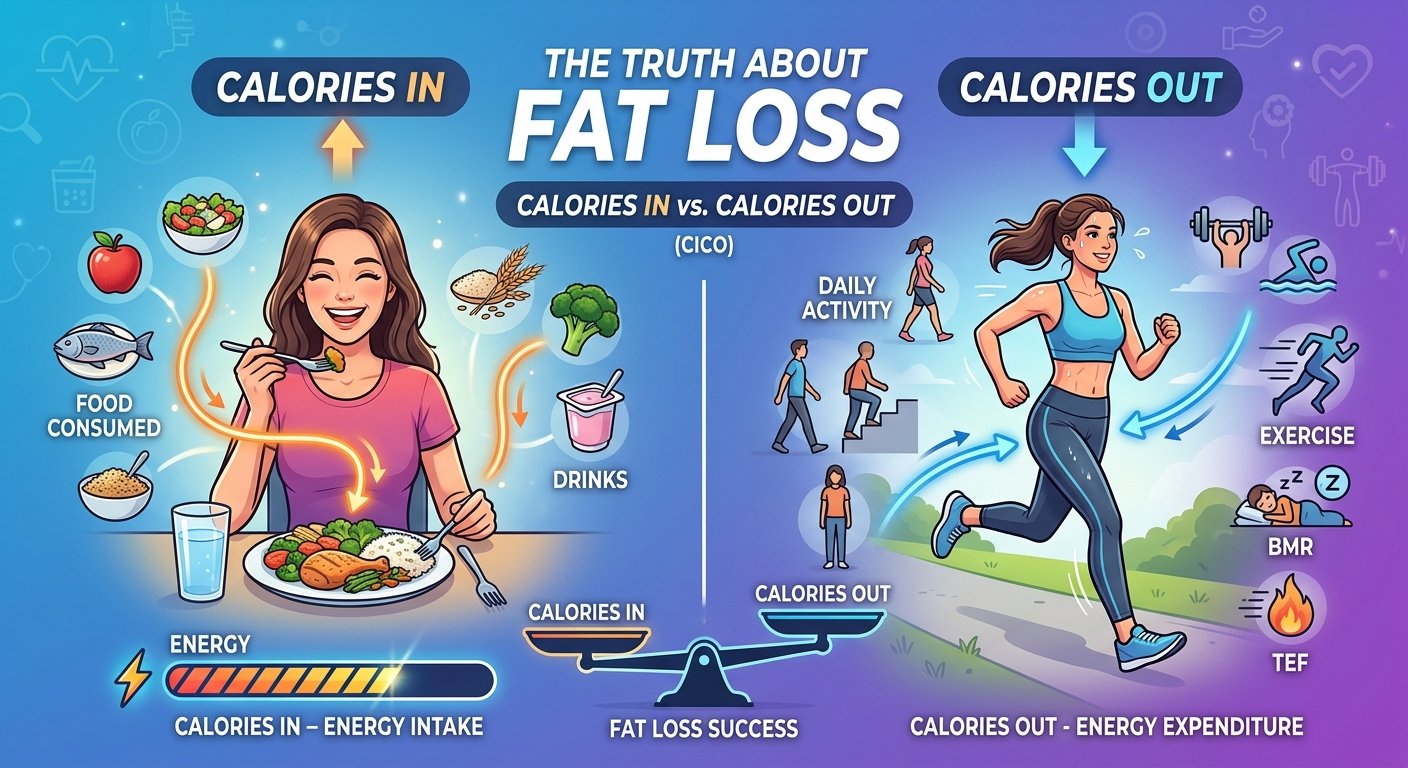
At the center of the fat-loss process is a simple concept: energy balance. Your body receives energy primarily from food and drinks, and it uses energy to maintain basic bodily functions, move, digest food, regulate temperature, and perform exercise. When energy intake is consistently lower than energy expenditure, the body must make up the difference by using stored energy, including stored body fat.
This is commonly summarized as “calories in vs. calories out.”
However, this phrase is often misunderstood. Saying that fat loss depends on calories does not mean that every calorie behaves identically in every situation, nor does it mean that nutrition quality, hormones, sleep, stress, muscle mass, hunger, genetics, or physical activity are irrelevant. These factors can influence appetite, energy expenditure, food choices, body composition, and how easy or difficult it is to maintain a calorie deficit.
The real truth is more nuanced:
A sustained calorie deficit is the fundamental requirement for losing body fat, but the way you create and maintain that deficit can make a major difference in health, hunger, performance, muscle retention, and long-term success.
This comprehensive guide explains the science behind calories, energy expenditure, calorie deficits, metabolism, exercise, nutrition, common fat-loss myths, and practical strategies for achieving sustainable results.
1. What Is Fat Loss?
Fat loss means reducing the amount of stored body fat.
Body weight is made up of several components, including:
- Body fat
- Muscle tissue
- Water
- Glycogen
- Bone
- Organs
- Digestive system contents
- Other tissues
Therefore, losing weight and losing fat are not exactly the same thing.
For example, someone might lose several kilograms during the first week of a very low-carbohydrate diet. A significant portion of that early change may come from water and glycogen rather than body fat.
Similarly, someone following a resistance-training program while eating enough protein may lose body fat while gaining or maintaining muscle. In that situation, body weight may change very slowly even though body composition is improving.
This is why fat loss should be evaluated using more than just the number on a scale.
Useful measurements can include:
- Body weight trends
- Waist circumference
- Progress photographs
- Clothing fit
- Strength levels
- Body composition measurements
- Energy and fitness levels
The scale is useful, but it does not tell the entire story.
2. What Are Calories?
A calorie is a unit of energy.
Food contains energy, and your body uses that energy to perform countless functions. The calories you consume primarily come from four macronutrients and related substances:
| Nutrient | Approximate calories per gram |
|---|---|
| Protein | 4 kcal |
| Carbohydrates | 4 kcal |
| Fat | 9 kcal |
| Alcohol | 7 kcal |
Fiber can also contribute energy depending on the type and how it is fermented in the digestive system.
Calories are not inherently “good” or “bad.” They are simply a measurement of energy.
However, foods containing similar calories can have dramatically different effects on:
- Hunger
- Fullness
- Nutrient intake
- Blood glucose
- Digestion
- Food volume
- Exercise performance
- Dietary adherence
For example, 500 calories from vegetables, lean protein, whole grains, and fruit will generally provide a very different eating experience from 500 calories of highly processed snacks.
This distinction is important.
Calories determine whether stored energy tends to increase or decrease, while food quality strongly influences health and how manageable the diet is.
3. Understanding Calories In vs. Calories Out
The basic energy-balance equation is:
Energy intake − Energy expenditure = Change in stored energy
If you consistently consume more energy than you use, the body stores the excess.
If you consistently use more energy than you consume, the body must obtain energy from stored sources.
For fat loss, the goal is generally to create a sustainable energy deficit.
For example, imagine that a person’s body uses approximately 2,400 calories per day on average.
If that person consistently eats around 2,000 calories, there is an approximate 400-calorie daily deficit.
Over time, that energy gap can contribute to weight and fat loss.
However, real-world weight loss is not perfectly linear. Body weight changes are affected by water, glycogen, sodium intake, digestion, hormones, physical activity, and adaptations in energy expenditure.
Therefore, calorie calculations should be treated as useful estimates rather than exact predictions.
4. What Is a Calorie Deficit?
A calorie deficit occurs when the body expends more energy than it receives from food and beverages over time.
There are two broad ways to create a calorie deficit:
Reduce calorie intake
You can consume fewer calories by changing:
- Portion sizes
- Food choices
- Cooking methods
- Snacks
- Sugary drinks
- High-calorie sauces
- Restaurant meals
- Alcohol intake
Increase energy expenditure
You can increase energy expenditure through:
- Walking
- Exercise
- Resistance training
- Sports
- Household activities
- Standing and moving more throughout the day
The most effective strategy for many people is a combination of moderate dietary changes and increased physical activity.
Trying to rely exclusively on extreme exercise or extreme food restriction can be difficult to maintain.
5. Why Calories Matter for Fat Loss
The human body needs energy to survive.
Even while sleeping, your body is using energy for:
- Breathing
- Circulation
- Brain function
- Temperature regulation
- Cell maintenance
- Organ function
- Hormonal processes
When your body does not receive enough energy from food to meet its needs, it can use stored energy.
Stored body fat is one of those energy reserves.
This is why a sustained calorie deficit is essential for meaningful fat loss.
You can eat extremely “clean” foods and still gain body fat if total energy intake consistently exceeds your body’s needs.
Conversely, a person can technically lose body fat while eating foods that are not traditionally considered “healthy” if total calorie intake remains sufficiently low.
However, that does not mean food quality is irrelevant.
A diet designed purely around calorie restriction may be nutritionally poor, difficult to maintain, and unsatisfying.
The better approach is to combine calorie awareness with nutritious, filling foods.
6. What Is Total Daily Energy Expenditure?
Your total daily energy expenditure, often abbreviated as TDEE, is the approximate amount of energy your body uses throughout an entire day.
TDEE consists of several major components.
Basal Metabolic Rate
Your basal metabolic rate, or BMR, represents the energy required to support essential physiological functions while the body is at rest.
BMR is influenced by factors such as:
- Age
- Sex
- Body size
- Body composition
- Genetics
People with greater amounts of metabolically active tissue generally require more energy at rest.
Physical Activity
Physical activity includes both structured exercise and everyday movement.
For example:
- Walking
- Running
- Cycling
- Swimming
- Weight training
- Playing sports
- Cleaning
- Gardening
- Climbing stairs
A person who walks 10,000 steps daily may expend substantially more energy through movement than someone who spends most of the day sitting.
Thermic Effect of Food
Your body also uses energy to digest, absorb, and process food.
This is called the thermic effect of food, or TEF.
Different macronutrients have different thermic effects.
Protein generally requires more energy to process than carbohydrates or dietary fat.
This is one reason a high-protein diet can be useful during fat loss.
Non-Exercise Activity
Not all physical activity is formal exercise.
Small movements throughout the day can add up.
Examples include:
- Walking around the house
- Standing
- Shopping
- Cooking
- Cleaning
- Taking stairs
- Moving at work
- Fidgeting
This category is often called non-exercise activity thermogenesis, or NEAT.
NEAT can vary considerably between people and even within the same person from one day to another.
7. Is Weight Loss Just Simple Mathematics?
At a basic level, energy balance follows physical laws.
But human weight management is more complicated than a simple calculator.
For example, suppose someone estimates that they need 2,500 calories per day and decides to eat exactly 2,000 calories.
Over time, weight may decrease.
But as body weight decreases, energy requirements can also change.
A lighter body generally requires less energy to move around.
Additionally, some people unconsciously reduce spontaneous activity when dieting. Hunger can increase, and the body may make physiological adaptations that reduce energy expenditure.
This means the original calorie deficit can gradually become smaller.
Therefore, calorie balance matters, but calorie balance is dynamic rather than fixed.
8. Why Weight Loss Often Slows Down
Many people experience rapid weight loss during the first few weeks and then become frustrated when progress slows.
This is normal.
Several factors can explain the change.
Initial water loss
When calorie or carbohydrate intake decreases, stored glycogen may decrease. Glycogen is stored together with water, so reductions in glycogen can produce rapid changes in body weight.
Lower body weight
As you become lighter, your body generally requires fewer calories.
Reduced movement
Dieting can sometimes reduce spontaneous physical activity.
Increased appetite
Hunger may increase, making it harder to maintain the original calorie deficit.
Metabolic adaptation
The body can respond to prolonged energy restriction by adjusting energy expenditure.
Tracking errors
Calories can be underestimated when people forget:
- Cooking oils
- Sauces
- Drinks
- Small snacks
- Larger portions
- Restaurant meals
Therefore, a plateau does not necessarily mean that fat loss is impossible.
It usually means the strategy needs to be evaluated and adjusted.
9. How Big Should a Calorie Deficit Be?
There is no single calorie deficit that works perfectly for everyone.
A moderate deficit is often easier to maintain than an extreme one.
Very aggressive calorie restriction can lead to:
- Excessive hunger
- Fatigue
- Poor training performance
- Reduced adherence
- Nutritional deficiencies
- Increased risk of losing lean tissue
A more sustainable approach is usually to create a manageable deficit while consuming sufficient protein and nutrient-dense foods.
The appropriate calorie target depends on:
- Body size
- Activity level
- Age
- Sex
- Current weight
- Goals
- Training
- Health status
People with medical conditions, a history of eating disorders, or other special circumstances should seek individualized professional guidance before making major dietary changes.
10. Protein and Fat Loss
Protein is particularly important during a fat-loss phase.
It can help with:
- Muscle maintenance
- Satiety
- Recovery
- Muscle protein synthesis
- Diet adherence
Good protein sources include:
- Eggs
- Chicken
- Fish
- Lean meat
- Greek yogurt
- Cottage cheese
- Milk
- Beans
- Lentils
- Chickpeas
- Tofu
- Tempeh
A diet with adequate protein combined with resistance training can help preserve lean mass while body fat decreases.
The exact protein requirement varies according to body size, activity, training, age, and overall diet.
11. Do Carbohydrates Make You Fat?
Carbohydrates are often blamed for weight gain.
But carbohydrates themselves do not automatically cause body-fat gain.
Carbohydrate-rich foods include:
- Rice
- Potatoes
- Oats
- Bread
- Pasta
- Fruits
- Beans
- Lentils
- Whole grains
These foods can fit comfortably into a fat-loss diet.
The key issue is total energy intake.
A person can lose fat while eating carbohydrates if they maintain an appropriate calorie deficit.
Some people prefer lower-carbohydrate diets because they find them easier to follow or because they experience improved appetite control.
Others perform better with more carbohydrates, particularly when they participate in demanding sports or high-volume training.
The best diet is often the one that supports nutrition, performance, satisfaction, and long-term adherence.
12. Does Dietary Fat Prevent Fat Loss?
Dietary fat is calorie-dense, providing approximately nine calories per gram.
This makes high-fat foods easy to overconsume.
However, dietary fat is not the enemy.
Healthy sources include:
- Nuts
- Seeds
- Avocados
- Olive oil
- Fatty fish
- Nut butters
Fat is involved in important biological processes and helps the body absorb fat-soluble vitamins.
The goal is not to eliminate fat.
Instead, control portions and choose sources that fit your nutritional needs and calorie target.
13. Fiber: The Secret Weapon for Satiety
Fiber can be extremely helpful during fat loss.
High-fiber foods often provide substantial food volume for relatively few calories.
Examples include:
- Vegetables
- Fruits
- Beans
- Lentils
- Whole grains
- Oats
- Seeds
Fiber can help people feel fuller and may support digestive health.
For someone trying to reduce calorie intake without constantly feeling hungry, increasing the proportion of high-fiber foods can be a practical strategy.
14. Why Food Volume Matters
Two meals can contain the same number of calories but have very different physical volumes.
For example, a large plate of vegetables, lean protein, and potatoes may contain fewer calories than a small dessert containing large amounts of added fat and sugar.
High-volume foods can make a calorie deficit easier because they allow people to eat satisfying portions.
Useful low-energy-density foods include:
- Vegetables
- Fruits
- Soups
- Potatoes
- Lean proteins
- Low-fat dairy
- Whole grains in appropriate portions
This is one reason calorie quality and food selection matter even though calorie balance ultimately determines stored energy.
15. Exercise and Fat Loss
Exercise is valuable for fat loss, but it is often misunderstood.
Many people assume that exercise alone will produce large amounts of weight loss.
In practice, people can easily consume enough calories to offset substantial amounts of exercise.
For example, a long workout may burn hundreds of calories, while a few high-calorie snacks can replace that energy quickly.
Exercise is still extremely valuable because it can:
- Increase energy expenditure
- Improve cardiovascular fitness
- Build or preserve muscle
- Improve insulin sensitivity
- Support mental well-being
- Improve strength
- Increase physical function
- Help maintain weight after weight loss
The best fat-loss strategy usually does not treat exercise as punishment for eating.
Instead, exercise should be viewed as an important component of overall health.
16. Why Strength Training Matters
Resistance training is especially useful during fat loss.
When calories are restricted, the body can lose both fat and lean tissue.
Strength training provides a stimulus that encourages the body to retain muscle.
Exercises can include:
- Squats
- Lunges
- Push-ups
- Rows
- Pull-ups
- Presses
- Deadlifts
- Resistance-band exercises
- Machine exercises
You do not necessarily need an advanced gym program.
A consistent, progressive resistance-training routine can be extremely beneficial.
17. Walking for Fat Loss
Walking is one of the simplest forms of physical activity.
It is accessible to many people and generally creates less recovery demand than intense exercise.
Increasing daily walking can help increase energy expenditure without requiring long gym sessions.
Practical ways to walk more include:
- Taking short walks after meals
- Parking farther away
- Using stairs
- Walking while talking on the phone
- Taking evening walks
- Walking during breaks
The goal is not necessarily a specific step count.
The important principle is to increase sustainable daily movement according to your individual circumstances.
18. Cardio vs. Strength Training
Both have benefits.
Cardio
Examples include:
- Running
- Cycling
- Swimming
- Brisk walking
- Rowing
- Dancing
Cardio can increase calorie expenditure and improve cardiovascular fitness.
Strength training
Resistance training helps develop strength and preserve or build muscle.
For many people, combining both is an excellent approach.
A balanced program might include several resistance-training sessions per week alongside regular walking and some cardiovascular activity.
The ideal routine depends on fitness level, schedule, preferences, and recovery capacity.
19. The Importance of Sleep
Sleep is often overlooked during fat loss.
Poor sleep can affect:
- Hunger
- Appetite
- Food choices
- Recovery
- Exercise performance
- Energy
- Mood
When people are exhausted, they may be more likely to choose highly palatable foods or skip exercise.
Good sleep does not replace a calorie deficit, but it can make healthy habits easier to maintain.
A consistent sleep schedule and a comfortable sleep environment can support a successful fat-loss lifestyle.
20. Stress and Fat Loss
Stress does not magically create body fat without an energy surplus.
However, stress can indirectly affect weight management.
For example, stress may lead to:
- Emotional eating
- Increased snacking
- Poor sleep
- Reduced physical activity
- Greater cravings
- Less consistent meal planning
Managing stress through healthy habits can therefore support long-term fat loss.
Useful strategies include:
- Walking
- Exercise
- Relaxation techniques
- Social connection
- Time management
- Hobbies
- Adequate sleep
21. Do You Need to Count Calories?
No.
Calorie tracking is one possible tool, not a requirement.
Some people enjoy tracking because it gives them a clearer understanding of portions and energy intake.
Others find tracking stressful or inconvenient.
Alternative strategies include:
Portion control
Use reasonable portions of protein, carbohydrates, fats, and vegetables.
Plate method
Build meals around vegetables, a protein source, and an appropriate portion of carbohydrate and fat.
Food swaps
Replace high-calorie foods with lower-calorie alternatives.
Mindful eating
Pay attention to hunger, fullness, and eating speed.
Consistent meals
Create a predictable meal structure that reduces random snacking.
The best method is the one you can consistently follow.
22. Common Calorie-Tracking Mistakes
People often underestimate calorie intake.
Common mistakes include:
Ignoring cooking oil
Oil is calorie-dense and can significantly increase the energy content of meals.
Estimating portions
A serving that looks small can contain more calories than expected.
Forgetting beverages
Sugary drinks, specialty coffees, juices, and alcohol can contribute substantial calories.
Restaurant food
Restaurant meals can contain more oil, butter, sugar, and sauces than expected.
Weekend overeating
A person may eat carefully throughout the week but consume a large calorie surplus on weekends.
Small snacks
A few bites here and there can add up.
Accurate tracking, at least temporarily, can help people understand their actual intake.
23. Is Intermittent Fasting Better for Fat Loss?
Intermittent fasting has become popular as a fat-loss strategy.
Common approaches include:
- Time-restricted eating
- 16:8 fasting
- Alternate-day fasting
- Longer fasting windows
Intermittent fasting can work for some people because it limits the time available for eating and may naturally reduce calorie intake.
However, fasting does not violate the laws of energy balance.
If someone consumes the same total calories and nutrients during their eating window, fasting does not create a magical fat-loss advantage.
Its primary benefit may be behavioral: it can help some people control intake.
For others, fasting may increase hunger and make overeating more likely.
24. What About Low-Carb Diets?
Low-carbohydrate diets can produce fat loss.
They may be particularly useful for people who find them satisfying and easy to follow.
Early weight loss can sometimes appear rapid because lower carbohydrate intake can reduce glycogen and associated water.
But long-term fat loss still depends heavily on overall energy balance.
A low-carb diet is one possible approach—not the only approach.
25. What About Keto?
A ketogenic diet severely restricts carbohydrate intake and increases the relative proportion of dietary fat.
It can lead to weight loss when it helps a person maintain an energy deficit.
However, keto is not automatically superior to every other diet for fat loss.
Some people enjoy it.
Others find it difficult because they miss foods such as:
- Bread
- Rice
- Pasta
- Potatoes
- Certain fruits
- Beans
Diet preference matters.
If a person cannot maintain a diet comfortably, its theoretical advantages become less meaningful.
26. Can You Lose Fat Without Exercise?
Yes.
It is possible to lose body fat through dietary calorie restriction alone.
However, exercise provides important benefits.
Resistance training can help preserve muscle, while cardiovascular and general physical activity improve fitness and health.
Therefore, exercise is not strictly required to create a calorie deficit, but it can make the overall process healthier and more effective.
27. Can You Gain Muscle and Lose Fat at the Same Time?
Yes, under certain circumstances.
This is often called body recomposition.
It may be more achievable for:
- Beginners
- People returning to training
- People with higher levels of body fat
- Individuals following structured resistance training
- People consuming adequate protein
The process generally involves resistance training, appropriate nutrition, sufficient protein, and controlled calorie intake.
Advanced lifters may find simultaneous muscle gain and fat loss more difficult.
28. The Truth About “Starvation Mode”
“Starvation mode” is often used online to describe the idea that eating too little automatically causes the body to stop losing fat.
This is an oversimplification.
The body does adapt to prolonged calorie restriction. Energy expenditure can decrease through several mechanisms.
However, this does not mean that a person can consume fewer calories than they expend indefinitely and somehow gain body fat from nowhere.
Instead, weight loss can slow because:
- Body mass decreases
- Movement decreases
- Metabolic adaptation occurs
- Tracking errors occur
- Water fluctuations hide fat loss
The solution is usually to evaluate the overall plan rather than assume that the body has broken the laws of physics.
29. Why the Scale Can Go Up During Fat Loss
This surprises many people.
You can be losing body fat while your scale temporarily increases.
Reasons include:
- Increased water retention
- High sodium intake
- Higher carbohydrate intake
- Muscle inflammation after training
- Hormonal changes
- Digestive contents
- Constipation
- Stress
- Poor sleep
For this reason, daily weight should not be interpreted in isolation.
A better approach is to monitor a trend over several weeks.
30. How to Track Progress Correctly
Try weighing yourself under similar conditions.
For example:
- In the morning
- After using the bathroom
- Before eating
- Wearing similar clothing
Instead of focusing on one measurement, calculate an average or observe the trend across multiple days.
Other useful measurements include:
Waist circumference
A shrinking waist can indicate reduced abdominal fat even when scale weight changes slowly.
Progress photos
Take photos under similar lighting, clothing, and posture.
Strength
Maintaining strength during fat loss can be a useful sign that muscle is being preserved.
Clothing fit
Changes in how clothing fits can provide valuable information.
31. Why “Healthy Foods” Can Still Cause Weight Gain
Foods can be nutritious and calorie-dense at the same time.
Examples include:
- Nuts
- Nut butter
- Olive oil
- Avocado
- Dried fruit
- Granola
These foods can absolutely be part of a healthy diet.
But portions matter.
Eating large quantities of healthy, calorie-dense foods can still make it difficult to maintain a calorie deficit.
This is an important distinction:
Healthy does not automatically mean low-calorie.
32. Why Liquid Calories Are Easy to Overconsume
Drinks can provide calories without creating the same level of fullness as solid foods.
Examples include:
- Sugary sodas
- Sweetened coffee
- Milkshakes
- Energy drinks
- Fruit drinks
- Alcohol
Reducing high-calorie beverages can be one of the simplest ways to reduce energy intake.
Water, unsweetened tea, and other low-calorie beverages can often make it easier to manage calorie intake.
33. The Role of Meal Timing
Meal timing is generally less important than total energy intake for fat loss.
Some people prefer:
- Three meals per day
- Five smaller meals
- Two larger meals
- Time-restricted eating
All of these can potentially work.
The best meal schedule is the one that helps you control hunger and maintain your overall calorie target.
Meal timing can matter for performance and personal comfort, but it does not override energy balance.
34. Does Eating Late at Night Cause Fat Gain?
Eating at night does not automatically cause body fat gain.
The primary issue remains total energy intake.
If someone eats within their calorie needs, eating at 9 PM does not inherently convert the food into fat simply because it is nighttime.
However, late-night eating can be problematic if it causes additional snacking and increases total calorie intake.
Therefore, the behavior surrounding nighttime eating matters more than the clock itself.
35. Does Breakfast Matter for Fat Loss?
Breakfast can be useful, but it is not universally mandatory for fat loss.
Some people enjoy breakfast and find it helps control hunger.
Others prefer delaying their first meal.
What matters most is the overall dietary pattern.
A healthy fat-loss diet can include breakfast—or not.
36. The Importance of Sustainable Habits
The best fat-loss diet is rarely the most extreme one.
If a diet requires:
- Constant hunger
- Avoiding social events
- Eliminating entire food groups unnecessarily
- Exhausting workouts
- Severe calorie restriction
it may be difficult to maintain.
A sustainable approach allows some flexibility.
You can include foods you enjoy while maintaining an appropriate overall calorie intake.
This is sometimes called the 80/20 approach, where most food choices are nutrient-dense while some less nutritious foods are enjoyed in moderation.
The exact ratio is not important.
Consistency is.
37. Building a Fat-Loss Plate
A simple meal structure can make healthy eating easier.
Consider building meals around:
Protein
Chicken, fish, eggs, yogurt, beans, lentils, tofu, or lean meat.
Vegetables
Choose a variety of vegetables for volume and micronutrients.
Carbohydrates
Rice, potatoes, oats, whole grains, fruit, or other carbohydrate sources.
Healthy fats
Nuts, seeds, olive oil, avocado, or fatty fish.
Portions can be adjusted according to individual calorie needs.
38. Example of a Simple Fat-Loss Day
Here is an example of a balanced eating pattern.
Breakfast
Eggs with whole-grain toast and fruit.
Lunch
Grilled chicken with rice and a large vegetable salad.
Snack
Greek yogurt with fruit.
Dinner
Fish or lean meat with potatoes and vegetables.
Optional treat
A small portion of a favorite dessert.
This is only an example.
A successful diet does not have to look exactly like this.
39. How to Make a Calorie Deficit Easier
Instead of dramatically reducing food intake, try small changes.
Increase vegetables
Add vegetables to lunch and dinner.
Choose lean protein
Protein can improve fullness.
Drink fewer sugary beverages
Liquid calories can add up quickly.
Use smaller portions of calorie-dense foods
Especially oils, sauces, nuts, and sweets.
Walk more
Increase everyday movement.
Eat slowly
Give your body time to recognize fullness.
Plan meals
Planning can reduce impulsive food choices.
40. How to Handle Hunger During Fat Loss
Hunger is normal when dieting, but extreme hunger should not be the goal.
Strategies that may help include:
- Eating enough protein
- Increasing fiber
- Choosing high-volume foods
- Drinking water
- Eating slowly
- Getting enough sleep
- Avoiding unnecessarily aggressive deficits
- Using foods you enjoy
- Maintaining regular meals
A diet that leaves you constantly starving is often too restrictive to be sustainable.
41. Fat Loss and Social Events
You do not need to avoid restaurants, parties, weddings, or family meals to lose fat.
Instead:
- Eat a protein-rich meal earlier
- Avoid arriving extremely hungry
- Choose reasonable portions
- Prioritize foods you genuinely enjoy
- Limit unnecessary liquid calories
- Return to your normal routine afterward
One meal does not determine your entire result.
Your overall pattern matters much more.
42. What Happens After You Reach Your Goal?
Maintaining weight loss can require ongoing habits.
After reaching a goal weight, calorie needs may increase compared with the dieting phase, but they are often lower than they were at the starting weight because the body is smaller.
Successful maintenance may involve:
- Continuing regular physical activity
- Monitoring weight trends
- Maintaining protein intake
- Eating mostly nutritious foods
- Keeping portions reasonable
- Allowing flexibility
Maintenance is not the end of the process.
It is a new phase.
43. Why Extreme Diets Often Fail
Extreme diets can produce rapid results, but rapid results do not automatically mean long-term success.
Problems may include:
- Severe hunger
- Fatigue
- Poor exercise performance
- Social difficulties
- Loss of lean tissue
- Nutritional inadequacy
- Rebound overeating
When someone returns to their previous eating habits, weight may return as well.
A slower approach that can be maintained for months and years is often more valuable than a dramatic short-term transformation.
44. Fat-Loss Myths You Should Stop Believing
Myth 1: Carbs automatically make you fat
False.
Excess energy intake is the central issue for long-term fat gain.
Myth 2: Eating fat makes you fat
Not automatically.
Dietary fat can be part of a healthy diet.
Myth 3: You must exercise every day
Not necessarily.
Regular movement and a sustainable exercise routine are more important than exercising every day.
Myth 4: You cannot eat dessert while losing fat
You can.
Portion and overall calorie intake matter.
Myth 5: Eating after 8 PM causes fat gain
The clock does not override energy balance.
Myth 6: Detox drinks burn body fat
Most detox products have little relevance to the fundamental process of fat loss.
Myth 7: Sweating means you are burning more fat
Sweating primarily helps regulate body temperature. It is not a direct measurement of fat loss.
Myth 8: A supplement can replace a calorie deficit
No supplement can eliminate the fundamental requirement for sustained energy deficit when the goal is reducing stored body fat.
45. Calories Are Important, But Nutrition Still Matters
It would be a mistake to conclude that only calories matter.
Two diets can contain the same number of calories but have very different nutritional value.
A nutrient-dense diet can provide:
- Vitamins
- Minerals
- Fiber
- Protein
- Essential fatty acids
- Phytonutrients
A diet based primarily on highly processed foods may make it harder to meet nutritional needs.
Therefore, the ideal fat-loss strategy combines:
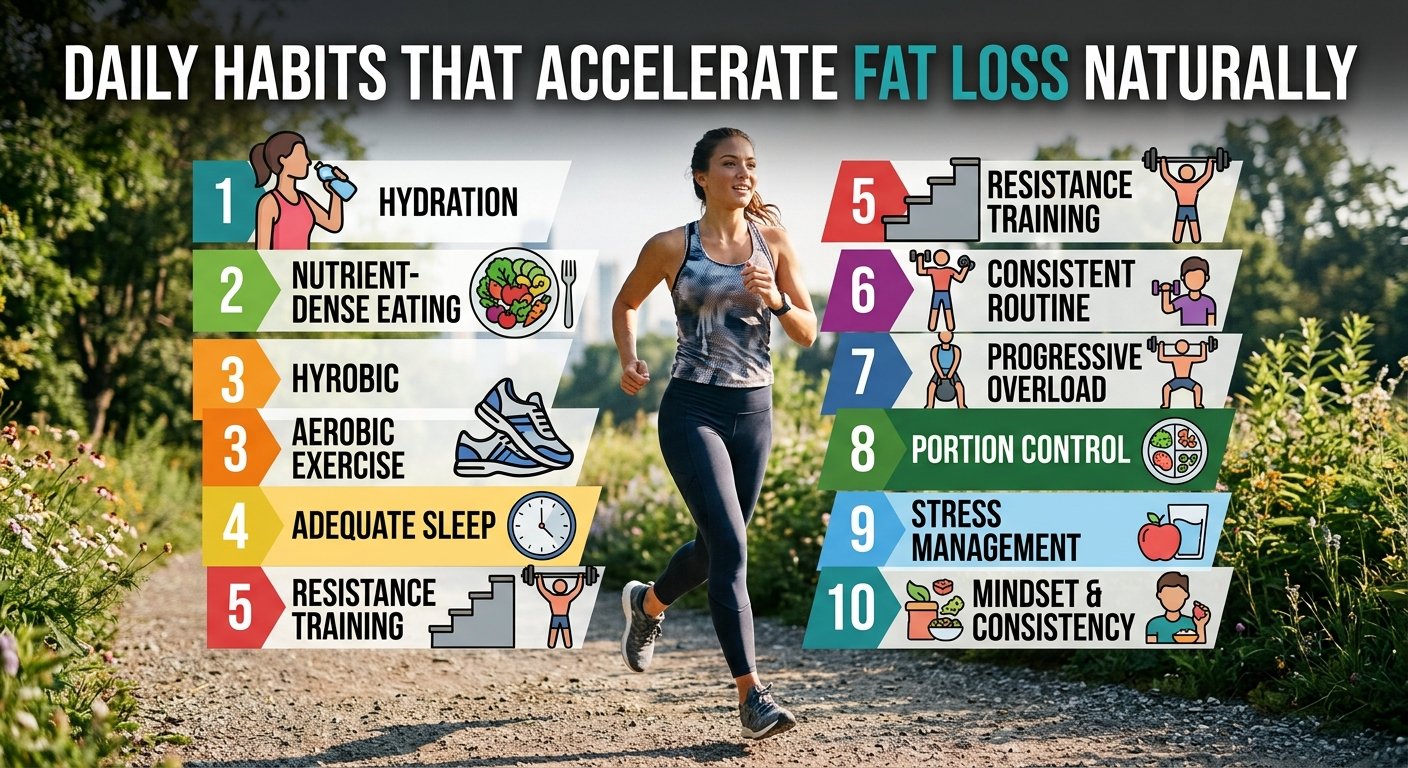
Calorie control + adequate protein + nutritious foods + physical activity + good sleep + sustainability.
46. The Psychology of Fat Loss
Fat loss is not only a biological process.
It is also behavioral.
People eat for many reasons:
- Hunger
- Habit
- Stress
- Boredom
- Social pressure
- Convenience
- Emotion
- Availability
Understanding your eating patterns can be as important as understanding calorie mathematics.
For example, someone might know exactly how many calories they should consume but repeatedly overeat at night because of stress or boredom.
In that situation, simply calculating a lower calorie target may not solve the underlying problem.
Behavioral strategies are essential.
47. Creating an Environment That Supports Fat Loss
Your environment influences your behavior.
Helpful strategies include:
- Keeping nutritious foods available
- Preparing meals in advance
- Portioning snacks
- Keeping high-calorie foods less accessible
- Carrying healthy snacks
- Planning restaurant meals
- Using smaller serving dishes
The goal is not to rely entirely on willpower.
Instead, make healthy choices easier.
48. How to Stay Consistent
Consistency does not mean perfection.
You will have days when:
- You eat more than planned
- You miss a workout
- You attend a party
- Your weight increases
- You feel unmotivated
The key is what happens afterward.
Avoid the “I already ruined my diet, so I might as well keep eating” mentality.
One high-calorie meal does not erase weeks of progress.
Return to your normal routine at the next meal.
49. A Practical Fat-Loss Strategy
A simple evidence-based approach might look like this:
Step 1: Establish your baseline
Understand your current eating and activity habits.
Step 2: Create a moderate calorie deficit
Avoid unnecessary extremes.
Step 3: Prioritize protein
Include a quality protein source in most meals.
Step 4: Eat plenty of vegetables and fruit
Increase food volume and nutritional quality.
Step 5: Include carbohydrates and fats
There is no universal need to eliminate either.
Step 6: Strength train
Use resistance exercise to support muscle retention.
Step 7: Increase daily movement
Walking is an excellent starting point.
Step 8: Sleep adequately
Recovery matters.
Step 9: Track progress
Use weight trends, waist measurements, photos, and performance.
Step 10: Adjust gradually
If progress stalls for several weeks, evaluate intake and activity before making major changes.
50. The Bottom Line: Calories In vs. Calories Out
The truth about fat loss is both simple and complex.
The simple part is this:
To lose stored body fat, the body generally needs to be in a sustained energy deficit.
If you consistently consume more energy than you expend, the body stores excess energy.
If you consistently expend more energy than you consume, the body draws on stored energy.
However, the complex part is that human energy expenditure changes over time, appetite varies, food tracking can be imperfect, and factors such as sleep, stress, activity, muscle mass, and diet composition influence how easy or difficult it is to maintain the necessary calorie deficit.
Therefore, successful fat loss should not be reduced to “eat less and exercise more.”
A better framework is:
Eat an appropriate amount of calories.
Prioritize protein and nutrient-dense foods.
Eat plenty of vegetables and fiber.
Perform resistance training.
Stay physically active.
Sleep well.
Manage stress.
Choose a strategy you can maintain.
The goal is not simply to become lighter.
The goal is to improve body composition while supporting health, strength, energy, and quality of life.
Frequently Asked Questions About Calories and Fat Loss
1. What is the most important factor in fat loss?
Maintaining a sustained calorie deficit is the fundamental requirement for reducing stored body fat.
2. Can I lose fat without counting calories?
Yes. Portion control, food selection, meal structure, and increased activity can create a calorie deficit without formal tracking.
3. Do carbohydrates prevent fat loss?
No. Carbohydrates can be included in a successful fat-loss diet.
4. Is eating fat bad for weight loss?
No. Dietary fat is necessary for normal health, but it is calorie-dense, so portions matter.
5. Does exercise burn enough calories to lose weight?
Exercise can contribute significantly to energy expenditure, but dietary intake also plays an important role.
6. Should I do cardio or weight training?
Both can be useful. Cardio supports cardiovascular fitness and energy expenditure, while resistance training helps preserve muscle.
7. Why did my weight stop decreasing?
Possible explanations include reduced energy expenditure, increased intake, water retention, reduced activity, or normal fluctuations.
8. Can I eat sweets while losing fat?
Yes. Small portions of enjoyable foods can fit into a balanced calorie-controlled diet.
9. Does eating at night cause weight gain?
Not automatically. Total energy intake is more important than the time of day.
10. Is intermittent fasting necessary?
No. Intermittent fasting is simply one dietary structure that may help some people control calorie intake.
11. How quickly should I lose weight?
The appropriate rate varies between individuals. A moderate, sustainable approach is generally preferable to extreme restriction.
12. Why is protein important during fat loss?
Protein supports muscle maintenance, recovery, and satiety.
13. Can walking help with fat loss?
Yes. Walking increases physical activity and energy expenditure and can be an accessible way to support a calorie deficit.
14. Can I lose fat and gain muscle simultaneously?
Yes, particularly in beginners and some other situations, although the process is more difficult for highly trained individuals.
15. Do detox drinks burn body fat?
No special drink can replace the basic requirement of maintaining an energy deficit for meaningful fat loss.
16. Do supplements accelerate fat loss?
Some products may have small effects, but supplements are not a substitute for nutrition, activity, and calorie control.
17. Why does weight change from day to day?
Daily changes can result from water, sodium, carbohydrates, digestion, hormones, and exercise—not just changes in body fat.
18. What foods are best for fat loss?
Foods that provide good nutrition and help control hunger include vegetables, fruits, lean proteins, whole grains, legumes, potatoes, and other minimally processed foods.
19. Do I need to avoid sugar completely?
No. Moderation and total calorie intake are more important than complete elimination.
20. What is the biggest mistake people make during fat loss?
One common mistake is choosing an overly restrictive strategy that cannot be maintained for the long term.
Conclusion
The truth about fat loss comes back to energy balance, but successful fat loss requires more than simply knowing that calories matter.
Calories provide the energy your body uses every day. When energy intake remains below energy expenditure over time, stored energy is mobilized, and body fat can decrease. This is the foundation of every successful fat-loss diet, regardless of whether the diet is low-carb, low-fat, intermittent fasting, Mediterranean-style, vegetarian, or based on another dietary pattern.
What differs is how people create and maintain that deficit.
A successful approach should reduce calorie intake without creating unnecessary hunger, provide adequate protein and nutrients, support physical activity, protect muscle, and fit comfortably into real life.
Instead of searching for a magical fat-burning food, perfect meal timing, or revolutionary supplement, focus on fundamentals.
Eat appropriate portions.
Prioritize protein.
Consume plenty of vegetables and fruit.
Choose nutritious foods most of the time.
Stay active.
Strength train.
Walk regularly.
Sleep well.
Track progress realistically.
And most importantly, develop habits that you can maintain.
Fat loss is not about finding a secret.
It is about understanding the fundamentals and applying them consistently.
Calories in vs. calories out is not a fad—it is the foundation of energy balance. The real skill is learning how to use that principle in a healthy, practical, and sustainable way.